Introduction
This page presents a factual account and financial analysis of my 15-year business relationship with Namecheap, which was terminated by their unilateral action and subsequent abandonment. Every statement below is supported by verifiable evidence, including transaction histories, email correspondence, and public domain pricing.
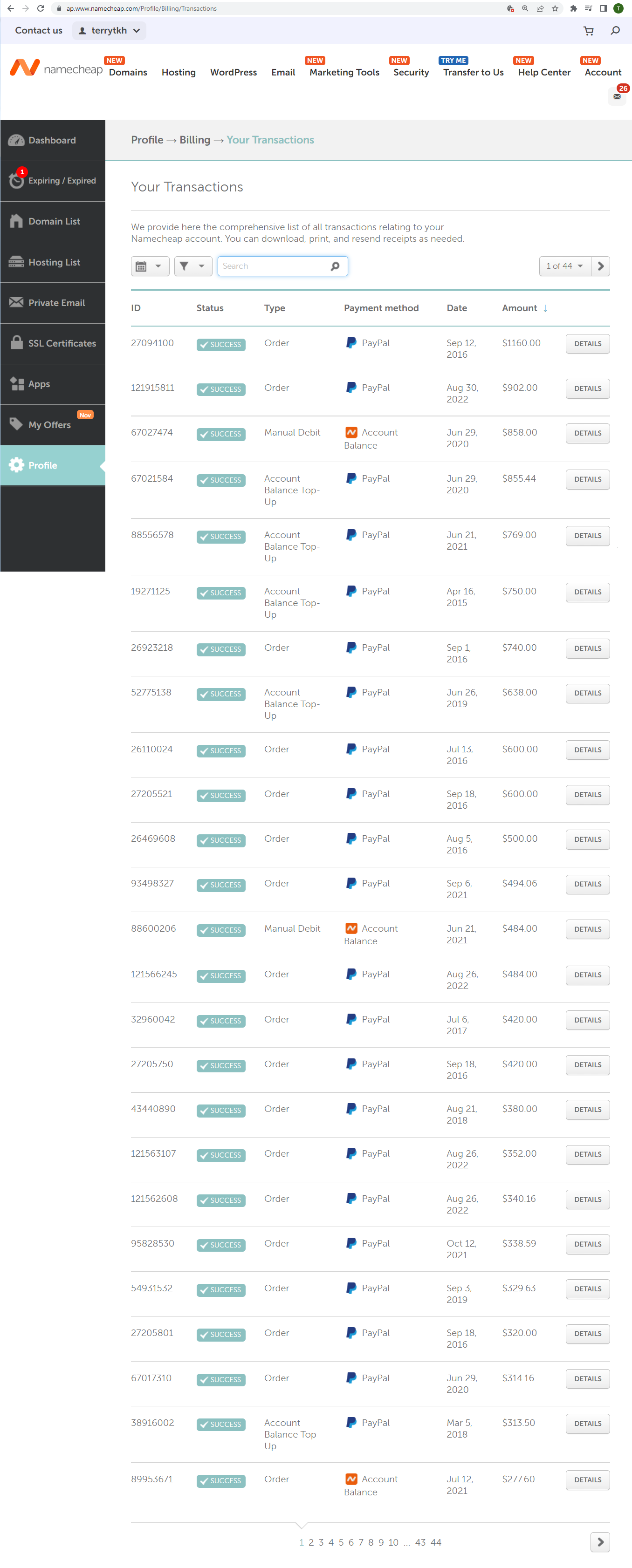
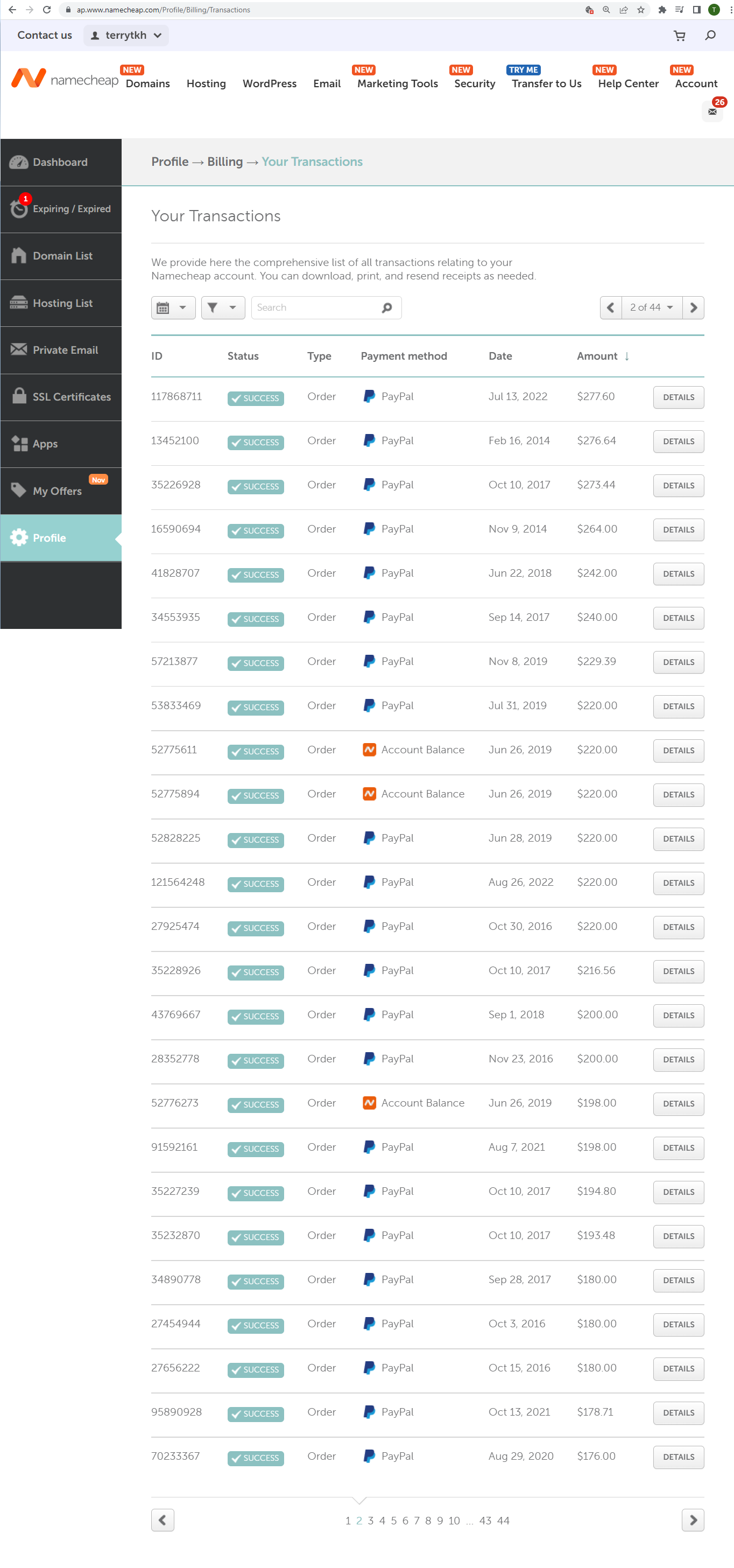
The following is a direct excerpt from my 44-page transaction history, showing the first two pages sorted from highest to lowest order value. This data is sourced directly from my Namecheap account and documents a history of approximately 1,100 successful financial transactions.
Part 1: The Verifiable Financial Profile of a Top-Tier Customer
The data presented here is sourced directly from my Namecheap account transaction history.
-
Transaction Volume: My account history spans 44 pages of transactions, with 25 individual orders per page. This documents a history of approximately 1,100 successful financial transactions with Namecheap.
-
Order Scale: The records show a pattern of high-value orders, not single-domain purchases. A sorting from highest to lowest reveals numerous transactions in the hundreds of dollars, with the single largest order being $1,160.00.
-
Portfolio-Driven Revenue Calculation: Based on the consistent pattern of high-value transactions in my account history, I maintained a portfolio of nearly 600 domains. A conservative, model-based estimate of the annual renewal revenue this portfolio generated is calculated as follows:
-
Assumption: ~450 domains were .co extensions.
-
Data Source: Namecheap’s standard, publicly-listed renewal price for a .co domain is $28.99/year.
-
Calculation: 450 .co domains × $28.99/year = $13,045.50 per year.
-
Assumption: The remaining ~150 domains are estimated as .com equivalents.
-
Data Source: Namecheap’s standard renewal for a .com domain is $15.98/year.
-
Calculation: 150 .com domains × $15.98/year = $2,397.00 per year.
-
-
Conclusion: The available evidence indicates that my account represented a predictable and recurring annual revenue stream for Namecheap of approximately $15,442.50.
This was not a small account. By their own transaction data, I was a significant, long-term source of revenue.
Part 2: The Irrational Business Decision
The core factual timeline is as follows:
-
Fact: The domain
malaysia.buildwas deleted from my account on December 5, 2023, while it had five months of valid registration remaining. -
Fact: No EPP code, transfer notice, or adequate explanation was provided prior to this deletion.
-
Fact: Namecheap’s support and legal departments provided contradictory reasons for the deletion over several weeks, before ceasing all communication on July 15, 2024.
Logical Inference:
Namecheap’s actions indicate a conscious business choice. To avoid a hypothetical cost or dispute over a single .build domain—a registry fee worth perhaps $60—the company made a decision that directly led to the loss of a client relationship demonstrably worth over $15,000 per year in renewal revenue alone.
The inescapable conclusion, based on their actions, is that Namecheap’s internal systems are so broken that they willingly incinerated a six-figure lifetime asset over a trivial sum. This is not a customer service failure; it is a catastrophic failure of business judgment.
Part 3: The Legal and Ethical Failure
As the registrar of record, Namecheap’s fundamental responsibilities are clear and established by ICANN policy and basic consumer contract law. My experience demonstrates a failure to meet these core obligations:
-
Duty to Safeguard: They failed to keep a paid-for domain secure in my account.
-
Duty to Communicate: They failed to provide standard notifications or a clear, consistent explanation.
-
Duty of Care: They failed to act as a responsible intermediary, instead blaming “upstream providers” before abandoning the matter entirely.
-
Fiduciary Breach: They accepted payment for a service, failed to deliver it, and then refused to provide a remedy or accountability.
The complete evidence of these failures is preserved at https://loss.co/responses/.

The Namecheap Failure That Proves My 15-Year Loyalty Meant Nothing
As the registrar of record and direct recipient of payment, Namecheap bears fundamental responsibility for the loss of the domain. Their core function was to ensure the domain remained secured in the account, particularly with auto-renewal enabled and payment collected. This duty of care included providing standard safeguards such as an EPP code for transfers, advance notification of any changes, and a clear explanation of any alleged violation—none of which were fulfilled. The registrant was left to discover the deletion independently. It is unequivocally NOT the registrant’s responsibility to navigate complex upstream provider relationships or contact various internet governance bodies; that duty falls squarely on the registrar, who serves as the customer’s sole point of contact. The comprehensive failure to fulfill these basic service obligations, while retaining payment, constitutes a fundamental breach of their contractual and fiduciary duty, placing the largest share of accountability for damages directly on Namecheap.
For nearly 16 years (Sep 1, 2010 – Jun 11, 2026), I entrusted Namecheap with my digital infrastructure. At its peak, my account held a portfolio of nearly 600 domain names. I was not a novice user or a one-time customer; I was a bedrock of their business, a testament to the trust I placed in their service.
This long-term partnership and significant revenue stream make their subsequent actions not just a service failure, but a profound betrayal. They did not merely fail a random customer; they systematically failed a loyal asset, demonstrating that no one, regardless of tenure or value, is safe from their negligence and abandonment.
15 Years of Business History — Now Publicly Verified
To demonstrate my longstanding reliance on Namecheap, I have published verifiable proof of our 15-year transaction history and the size of my past portfolio. The video is live and accessible to regulators, press, and governance bodies:
See https://youtu.be/_fR9ETHZiSM
(With English auto-translated subtitles)
The $15,000-a-Year Question Namecheap Won’t Answer
Why would a company systematically dismantle a 15-year client relationship worth an estimated $15,000 per year? The documented transaction history and renewal math reveal the staggering financial miscalculation behind Namecheap’s negligence. This was not a simple error; it was a catastrophic business decision.
Ironically, the Thanksgiving weekend (Black Friday and Cyber Monday) I once anticipated ACTIVELY for Namecheap’s biggest promotions has now become a permanent memorial to their betrayal, transforming me from a loyal “whale” customer into someone who will never again look at their offers.
See the Verifiable Financial Breakdown and Evidence Here
This demonstrates that the impact on me is not theoretical — it is quantifiable, documented, and ongoing.
* While this analysis focuses on Namecheap’s primary responsibility, this does not absolve other parties of their failures. The complete breakdown across the entire ecosystem – including Enom’s communication blackout, the .BUILD Registry’s silence, and ICANN’s procedural failures – is documented in detail on the respective case pages. However, as the registrar of record and the party that accepted direct payment, Namecheap bears the ultimate responsibility to the customer for managing these relationships and ensuring service delivery.