The interpretations and conclusions below represent my sincerely held view based on the documented correspondence, ICANN Bylaws, and Ombudsman Charter provisions cited.
ICANN Ombudsman Complaint Declined: Why “Out of Scope” Reveals a Systemic Accountability Gap
Full email from the ICANN Ombudsman (9 Dec 2025) and entire correspondence thread: See the complete email https://loss.co/ombudsman-board-complete-email-trail/#9121249
Domain: malaysia.build
ICANN Contractual Compliance Case: #01448650
Ombudsman Decision: 9 December 2025
This document provides conclusive evidence that the Ombudsman’s ‘out of scope’ refusal is the final nail in a coffin of accountability, demonstrating a critical and structural failure of ICANN’s accountability system.
This failure is not incidental but structural: the mechanisms designed to ensure fairness are fundamentally incapable of addressing harm caused by ICANN’s own procedural inaction and delay.
The Ombudsman—ICANN’s ‘independent’ fairness mechanism—took 70 days to decline the case using its own procedural delays as justification. The office meant to catch accountability failures became the accountability failure.
This creates a profound and systemic irony: the office created to ensure fairness within ICANN is rendered powerless precisely when fairness is most needed—when the delay and opacity originate from ICANN itself. It is the equivalent of an internal auditor who can only investigate financial discrepancies after the accounts have been finalized and closed—a guarantee that real-time errors will never be caught.
This statement constitutes neither a personal attack nor an informal grievance. It is a formal, evidence-based critique of a governance failure that exposes and institutionalizes a critical oversight gap.
- Jurisdiction Confirmed by the Ombudsman
The Ombudsman explicitly confirmed:
- Jurisdiction is limited to ICANN staff, Board, and constituent bodies
- Contractual Compliance actions are within scope
- The office may examine whether staff followed required processes and provided timely and reasoned responses
- Fairness may only be evaluated after Contractual Compliance issues a “final decision”
- What the Complaint Actually Concerned
The complaint never asked the Ombudsman to:
- overturn policy
- sanction registrars or the registry
- rule on the domain deletion itself
It concerned only ICANN staff conduct:
- >180 days of unresolved delay by Contractual Compliance
- repeated non-responses
- broken official promises
- contradictory and erroneous information when a response finally arrived
- complete silence on follow-up questions
All of the above fall squarely within the Ombudsman’s stated mandate as defined in the ICANN Bylaws Article V and the Ombudsman Charter §3.2(a), which explicitly covers “delay,” “lack of responsiveness,” and “failure” to follow stated processes.”
- Documented Timeline
- 11 July 2025 – Initial complaint to Contractual Compliance
- 1 October 2025 – First escalation to Ombudsman after 82 days of no substantive reply from Compliance
- 3 October 2025 – Compliance promises “detailed response is being worked on”
- 5 November 2025 – After 117 days of silence and only 9 hours after a public campaign + Malaysian GAC complaint, Compliance issues a document riddled with contradictions, wrong audit dates, and errors
- 7 November 2025 – Ten specific questions sent to Ombudsman (still unanswered)
- 9 December 2025 – Ombudsman declines the case as “out of scope”
* My characterization of the 5 November 2025 response as containing “contradictions, wrong audit dates, and errors” is based on a direct, documented conflict within the ICANN Compliance team’s own correspondence.
See https://loss.co/icann-contractual-compliance-complete-email-trail/#5111004
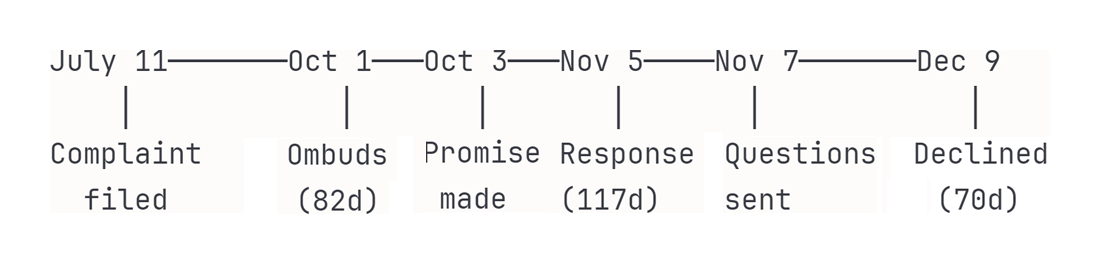
Time Ombudsman held the case before declining: 70 days
Total elapsed time from initial complaint to Ombudsman refusal: 152 days
- The Multi-Layered Catch-22: How the Ombudsman’s “Out of Scope” Reasoning Creates a Perfect Accountability Vacuum
I. Trigger & Preconditions Paradoxes
Catch-22 #1 — The Final-Decision Gatekeeper
Ombudsman’s Statement:
“I cannot open a case until you have received a conclusion or decision from Contractual Compliance.”
Reality:
The complaint was that Compliance would not issue a decision.
Paradox:
Review cannot begin until the condition being complained about (absence of a decision) is resolved by the department being reviewed.
Effect:
Indefinite delay is immune from review.
Catch-22 #2 — Inaction Is “Not Inaction”
Ombudsman’s Statement:
“If there is an inaction, this too would be subject to an Ombuds review… you have now received a response so this is not an ‘inaction.’”
The Paradox:
119 days of silence was ruled “not inaction” because a late response eventually arrived, retroactively erasing the entire period of delay from reviewability.
Effect:
Any delay can be immunized by sending one late email.
Catch-22 #3 — The Perpetual “Not Yet”
Ombudsman’s Statement:
“The Ombuds Office requires a final decision to proceed… because the Ombuds Office cannot determine if someone has been unfairly treated until there is an action or a decision to investigate.”
The Paradox:
-
Before a decision: Too early to review.
-
During delay: Still pending.
-
After a decision: The response itself becomes a “policy/administrative” matter, placing it out of scope.
Effect:
The moment for review never arrives.
Catch-22 #4 — The “During Process” Immunity
Ombudsman’s Statements:
“I can assess whether they have treated you fairly by: (i) following the required processes and policies…”
“having the final decision also allows the Ombuds Office to determine whether the issues… are within the Ombuds Office scope”
The Paradox:
The Ombudsman can review whether staff followed process, but states that a “final decision” is required to determine if an issue is even within scope. This makes the completion of the staff process a precondition for reviewing conduct during that process.
Effect:
Real-time unfairness cannot be checked.
II. Scope Contradiction Paradoxes
Catch-22 #5 — The In-Scope / Out-of-Scope Loop
Ombudsman’s Statements:
“The only party mentioned in your correspondence that the Ombuds Office can investigate for unfair treatment is ICANN staff…”
“As you now have a response from Contractual Compliance and the issues you have raised in your correspondence are out of scope for the Ombuds Office…”
The Paradox:
The Ombudsman confirms that ICANN staff conduct is its sole jurisdiction, then declares documented staff conduct (delay, contradictions) “out of scope.”
Effect:
The only category the Ombudsman can review becomes the one category it will not review.
Catch-22 #6 — Third-Party Association Shield
Ombudsman’s Statement:
“Further communications from you refer to complaints about eNom, Namecheap and .build, however none of these parties is in scope for the Ombuds Office.”
The Paradox:
Complaints about staff’s handling of issues involving third parties are reclassified as complaints about those third parties.
Effect:
A large portion of ICANN staff’s core operational work becomes shielded.
Catch-22 #7 — Remediation Misclassification
Ombudsman’s Statement:
“The remediation you are seeking… is also outside the scope of the ICANN Ombuds.”
The Paradox:
The Ombudsman’s inability to grant a specific remedy (domain restoration) is used as justification not to investigate the fairness of the process that denied that remedy.
Effect:
Process-review becomes impossible whenever substantive harm exists.
Catch-22 #8 — Pre-Review Judgment
The Paradox:
To declare your issues “out of scope,” the Ombudsman must have evaluated their substance and context. This constitutes a preliminary review, which is then used to justify refusing to conduct a review.
Effect:
The refusal is itself an unacknowledged form of review, performed without transparency or recourse.
III. Process Evaluation Paradoxes
Catch-22 #9 — The Process Black Hole
Ombudsman’s Statements:
“I can assess whether they have treated you fairly by: (i) following the required processes and policies…”
“The Ombuds Office requires a final decision to proceed…”
The Paradox:
The Ombudsman is mandated to evaluate whether staff followed process, but is forbidden from beginning this evaluation until after the process is complete.
Effect:
No real-time correction; only post-mortem commentary.
Catch-22 #10 — The Unreviewable Final Decision
Ombudsman’s Statement:
“I cannot overturn decisions made by Contractual Compliance, nor can I determine whether the decisions they have made are correct.”
The Paradox:
A “final decision” is required to trigger review, but the Ombudsman is prohibited from assessing the correctness or factual basis of that same decision.
Effect:
The decision needed to trigger review cannot itself be substantively reviewed.
Catch-22 #11 — Contradictions Cannot Be Examined
Ombudsman’s Conflicting Mandates:
“I can assess whether they have treated you fairly by:… (ii) giving you responses with reasons for those responses.”
“I cannot… determine whether the decisions they have made are correct.”
The Paradox:
Assessing whether a “response with reasons” is fair requires examining if those reasons are contradictory or erroneous. This is defined as assessing “correctness,” which is prohibited.
Effect:
Fairness cannot be evaluated without examining factual correctness, making the core function impossible.
IV. Timeliness & SLA Paradoxes
Catch-22 #12 — Delay as the Official Remedy
The Paradox:
When the absence of a decision was challenged, the Ombudsman invoked its own Service Level Agreement (SLA), prescribing up to 120 more days of process on top of the existing 119-day delay.
Effect:
Delay became the official remedy for delay..
Catch-22 #13 — Selective SLA Enforcement
The Paradox:
The Ombudsman’s mandate is to ensure ICANN staff act fairly, which includes following their own published processes. By repeatedly breaching its own 3–5 day acknowledgment SLA without consequence while adjudicating the fairness of others’ timeliness, it demonstrates the very unfairness it is meant to police.
Effect:
Timeliness standards are binding on the complainant but not on the office.
Catch-22 #14 — The Acknowledgment Without Action
Ombudsman’s Statement:
“I acknowledge that you felt like you were in a ‘catch 22’… I also understand that felt the response timeframe to be unjustified. Please be aware that I am not taking a view about whether the timeframe for response was justified or not.”
The Paradox:
The Ombudsman validates my experience of unfairness but explicitly states this recognition has no bearing on its decision to act or its view of the facts.
Effect:
The acknowledgment becomes a procedural formality, divorced from substantive justice.
V. Information & Transparency Paradoxes
Catch-22 #15 — The Unanswered Questions Trap
The Paradox:
I submitted 10 questions to clarify scope and standards. The Ombudsman declined the case without answering them, stating it “cannot help you resolve your issue.”
Effect:
I cannot understand scope without answers, and the office declines to answer because it claims the matter is out of scope.
Catch-22 #16 — The Confidentiality Cloak
Ombudsman’s Statement:
“As ICANN Ombuds, I am independent and all matters brought to me as Ombuds will be treated as confidential.”
The Paradox:
Confidentiality protects the complainant but also prevents public scrutiny of the Ombudsman’s reasoning for declining cases.
Effect:
Patterns of refusal and internal criteria cannot be examined, blocking accountability for the accountability office.
Catch-22 #17 — The Closed Feedback Loop
The Paradox:
The Ombudsman’s “out of scope” decision is itself an act of ICANN staff. No internal mechanism exists to appeal this decision or review the fairness of the Ombudsman’s own process.
Effect:
The fairness office is the final, unreviewable authority on its own fairness.
VI. Structural & Mission Paradoxes
Catch-22 #18 — The Independent Mechanism That Depends on Compliance
Ombudsman’s Statement:
“The Ombuds Office requires a final decision to proceed…”
The Paradox:
The “independent” office cannot act unless the department it oversees (Contractual Compliance) acts first. The reviewed party controls the trigger for review.
Effect:
Dependence masquerades as independence.
Catch-22 #19 — The Fairness Advocate Who Cannot Advocate
Ombudsman’s Statement:
“The Ombudsman shall serve as an objective advocate for fairness…”
The Paradox:
The mandate is to advocate for fairness, but the office’s constraints (cannot assess correctness, cannot review mid-process) prevent it from taking a substantive position where fairness is most contested.
Effect:
Advocacy is impossible where advocacy is needed most.
Catch-22 #20 — The Community Member Exclusion
Ombudsman’s Statement:
“The principal function of the Ombudsman shall be to provide an independent internal evaluation of complaints by members of the ICANN community…”
The Paradox:
As a registrant, I am a member of the ICANN community the Ombudsman is mandated to serve. By declaring my complaint “out of scope,” the mechanism becomes inaccessible to me.
Effect:
I am defined as a beneficiary but functionally excluded from the service.
Catch-22 #21 — Precedent of Inaction
The Systemic Paradox:
Each “out of scope” dismissal for procedural delay sets a silent precedent. It signals that extended inaction will not trigger Ombudsman review.
Effect:
Not enforcing the rules against delay becomes the new, unwritten rule, systemically incentivizing further delay.
Catch-22 #22 — The Illusion of Alternative Remedies
Ombudsman’s Statement (quoted):
“Another option would be for you to review the ICANN accountability mechanisms such as the Request for Reconsideration or the Independent Review Process…
…you may submit a complaint to the ICANN Complaints Office…”
The Paradox:
The Ombudsman redirects me to ICANN mechanisms that cannot address the problem I raised:
- Request for Reconsideration (RfR)
This mechanism applies only to:
- ICANN Board actions,
- ICANN staff actions that contradict policy, or
- ICANN actions based on false or inaccurate information.
But my case involves non-action, siloed delay, and contradictory communication — none of which fit the standard criteria.
Thus, the mechanism I am told to use is designed not to apply.
- Independent Review Process (IRP)
The IRP:
- reviews whether ICANN acted inconsistently with its Articles or Bylaws,
- costs tens of thousands of dollars,
- is structured for disputes involving corporate or national stakeholders, not an individual registrant.
Thus, the Ombudsman recommends a mechanism that is financially inaccessible and categorically mismatched to my case.
- ICANN Complaints Office
The Complaints Office:
- explicitly does not review case-level decisions or actions involving Contractual Compliance,
- does not review Ombudsman decisions,
- does not provide remedies,
- and frequently redirects complainants back to Compliance or the Ombudsman.
Thus, the office I am directed to is incapable of reviewing the topic you would complain about.
Why This Forms a Catch-22
I can’s use the Ombudsman because the matter is “out of scope.”
But the Ombudsman refers me to mechanisms whose scope excludes my issue.
The only available avenues are those in which the very problem I am experiencing (delay, contradiction, refusal to act) is not a valid basis for review.
This creates a circular no-exit structure:
- Ombudsman → “Use other mechanisms.”
- Other mechanisms → “We cannot review Compliance delays or Ombudsman refusals.”
- Me → left without any mechanism that accepts jurisdiction.
- Result → The system has “remedies,” but none can be triggered.
Effect:
A perfect accountability illusion!
ICANN appears to offer multiple escalation pathways, yet all of them are structurally incapable of addressing the type of harm I suffered.
The Ombudsman’s redirection functions as a procedural escape hatch — outwardly helpful, but inwardly leading only to mechanisms that cannot help.
The twenty-two Catch-22s detailed above are not a list of random failures; they are the exposed wiring of a system in systemic failure. They reveal a paradox that is not incidental but foundational: the Ombudsman’s operational rules inherently negate its stated mandate.
The office is architecturally conflicted. It is an advocate prohibited from advocacy, an observer that cannot scrutinize, a confidential process that blocks public accountability, and a community service that functionally excludes the community it is meant to serve. These are not correctable flaws but designed features—a bureaucratic blueprint for simulating oversight while nullifying it.
The cumulative effect is a perfect accountability vacuum. Each paradox functions as a procedural deadbolt. Together, they form an impenetrable logical vault, ensuring that ICANN staff conduct is shielded from meaningful, timely, or independent review. The mechanism created as a remedy for unfairness becomes the instrument that perpetuates it, trapping complainants in a chamber of circular reasoning with no exit.
This leads to the inescapable, ultimate conclusion: ICANN’s accountability framework is only operational when it is not needed to hold ICANN accountable. The moment its core function—checking ICANN’s own power—is required, the system deconstructs into the very Catch-22s it was built to resolve. This isn’t a bug. It is the fatal design flaw of the model itself.
- Eight Issues Indisputably Within the Ombudsman’s Mandate (Yet Declared “Out of Scope”)
All eight concern only ICANN staff conduct and match the Ombudsman Charter §3.2(a) and Bylaws Article 5 wording verbatim:
| # | Issue (all documented) | Exact Ombudsman mandate that covers it |
| 1 | >180 days of delay by Contractual Compliance | “delay” and “failure to follow stated processes” |
| 2 | Repeated total non-response to correspondence | “lack of responsiveness” |
| 3 | 3 October 2025 official promise of a detailed response that was never honored until external pressure | failure to follow through on staff commitments |
| 4 | Delivery (5 Nov) of a “detailed response” full of contradictions, wrong dates, and errors | staff providing inaccurate / contradictory information |
| 5 | Ongoing refusal to answer follow-up questions raised by that flawed response | continued “lack of responsiveness” |
| 6 | Ombudsman’s own repeated breaches of its 3–5 day acknowledgment SLA | the Ombudsman must follow its own published standards |
| 7 | Treating the file as “new” on 6 Nov despite holding it since 1 Oct, artificially restarting its clock | arbitrary / unfair process by Ombudsman staff |
| 8 | Prescribing 120 more days of delay when the complaint was about 119+ days of existing delay | failure to act “in a reasonable time” and “fairly” (Bylaws Art. 5 §4) |
The remaining two questions from 7 November touched on registry policy and are acknowledged as outside scope.
Summary: 8 out of 10 questions dismissed as “out of scope” despite explicit mandate coverage.
- Why “Out of Scope” Cannot Logically Stand
Every point above relates exclusively to the timeliness, responsiveness, accuracy, and fairness of ICANN staff—the precise areas the Ombudsman exists to police. Declaring them “out of scope” directly contradicts the office’s own published Charter and Bylaws.
The Ombudsman took 70 days to determine it couldn’t review 180 days of delay—a timeline that itself demonstrates the very “lack of responsiveness” the office exists to address.
The Accountability Loop: ICANN’s Ombudsman Mirrors Namecheap’s Deflection Playbook
The Ombudsman’s refusal to open the case is structurally identical to Namecheap’s response pattern documented at
https://loss.co/responses/
| Deflection Tactic | Namecheap (Registrar) | ICANN Ombudsman (Accountability Office) |
| Shifting Responsibility | “Please rest assured that as soon as we received your request, we submitted it to our upstream provider” (July 7, 2025) | “As you now have a response from Contractual Compliance and the issues you have raised… are out of scope” (December 9, 2025) |
| Declaring Non-Responsibility | “The responsible party in this case is the .Build Registry” (July 15, 2025) | Declares staff conduct issues “out of scope”; responsibility lies with Contractual Compliance (outside review until “final decision”) |
| Premature Closure | “This email will be closed now” (July 15, 2025) | “The Ombuds Office regrets that it cannot help you… will decline to accept your case” (December 9, 2025) |
| Redirection Without Resolution | “If you have any further questions, please do not hesitate to contact our Legal team directly at legal@namecheap.com.” (Jul 15, 2025) | Redirected to Request for Reconsideration, Independent Review Process, and Complaints Office |
| Final Disclaimer | “Namecheap was not involved in and is not responsible for the transfer” — Legal Department (July 15, 2025) | Declined jurisdiction over the very ICANN staff whose conduct falls within its published mandate |
| Time to Decline | 35 days (Jun 11 – Jul 15) | 70 days (Oct 1 – Dec 9) |
The Pattern:
- Both entities exist within ICANN’s accountability chain.
- Both refused to investigate.
- Both pointed elsewhere.
- Both closed the matter without resolution.
The only difference is that Namecheap took 35 days to decline; the Ombudsman took 70 days to reach the same conclusion.
When every entity in the accountability chain declares itself “not responsible” and points to another party, accountability disappears entirely. This is not a series of individual failures—it is a systemic design that enables institutional avoidance.
- Why This Matters Beyond One Domain
When prolonged inaction by ICANN staff:
- cannot trigger Ombudsman review,
- blocks any final decision, and
- is shielded by a second layer of Ombudsman-created delay,
any registrant can be left in limbo indefinitely with no effective internal remedy.
This means
- a registry could ignore ICANN policy indefinitely,
- compliance could refuse to act,
- and no internal mechanism exists to compel a decision or
- even acknowledge the procedural failure.
This is a systemic accountability failure!
- Critical Unanswered Questions & Formal Request for Clarification
The Ombudsman’s “out of scope” decision leaves the following procedural and systemic questions unresolved. I formally request written clarification on:
-
The Reviewability of Procedural Delay: If 180+ days of delay with documented non-responses doesn’t meet the threshold for ‘delay’ and ‘lack of responsiveness’ under Charter §3.2(a), what does? Please provide the specific standard.
-
Justification for the “Out of Scope” Finding: Why were the eight documented instances of ICANN staff conduct—explicitly concerning delay, non-responsiveness, and procedural errors—dismissed as “out of scope” without substantive explanation?
-
Pathway for Those in “Decision Limbo”: What is the designated, practical recourse for a registrant when ICANN staff simply refuse to issue any decision, thereby nullifying all standard review pathways?
Given the Ombudsman’s documented, repeated breaches of its own 3–5 day acknowledgment SLA while handling this case, I will watch the calendar with interest—hopefully, this time, the standards of timeliness will be met.
Conclusion
The 9 December 2025 “out of scope” decision does not reflect individual fault. It reveals that the current rules contain a critical design gap: they provide no timely oversight when the harm is indefinite procedural inaction by ICANN org itself.
The accountability mechanisms at ICANN work—until you need them to hold ICANN itself accountable. That’s not a bug in the system; it’s a design flaw that undermines the entire multi-stakeholder model.
That gap deserves open discussion and repair in the interest of every registrant and the credibility of ICANN’s governance.
P.S.
If you want to understand precisely how the ICANN Contractual Compliance team and the ICANN Ombudsman handled my case—the documented delays, contradictory information, and ultimate “out of scope” refusal—you can review the complete record on my accountability page:
-
ICANN Contractual Compliance Process: https://loss.co/responses/#icann
-
ICANN Ombudsman Review & Decision: https://loss.co/responses/#ombuds